Formaldehyde standards for cabinets in the US come from TSCA Title VI, the federal rule that matches California's CARB Phase 2 limits. They cap formaldehyde emissions from the hardwood plywood, particleboard and MDF inside a cabinet, and require those panels and the finished cabinets to carry a compliance label.
Summary
- TSCA Title VI is the national rule; its emission limits are set at the same levels as CARB Phase 2.
- The rule covers composite wood: hardwood plywood, particleboard, MDF and thin MDF, plus finished goods such as cabinets made with them.
- Since March 22, 2019, regulated products need a TSCA Title VI label; a CARB-only label is no longer enough.
- Before you order from any supplier, ask how the panels are certified and check the label on the carton or cabinet.
What the Formaldehyde Rules Regulate
The rules limit how much formaldehyde composite wood panels can release into the air. Formaldehyde is part of many adhesives used to bond wood fibers and veneers, so the rules target the panels, not solid wood.
Two rules matter for cabinets sold in the US. California's Air Resources Board adopted the Airborne Toxic Control Measure for composite wood in 2007; its second, stricter stage is known as CARB Phase 2. Congress then added Title VI to the Toxic Substances Control Act in 2010, and EPA published the rule that puts it into practice in December 2016. That federal rule is what most people mean by TSCA Title VI.
EPA set the federal limits at the same levels as CARB Phase 2, so a panel that meets one meets the other on emissions. The difference today is the label, covered below.
Emission Limits by Panel Type
Each panel type has its own limit, measured in parts per million (ppm). Lower is stricter.
| Composite wood panel | Emission limit | Where it shows up in cabinets |
|---|---|---|
| Hardwood plywood (veneer or composite core) | 0.05 ppm | Cabinet boxes, backs, shelves |
| Particleboard | 0.09 ppm | Boxes and shelves in many lower-cost lines |
| Medium-density fiberboard (MDF) | 0.11 ppm | Door panels, painted parts, moldings |
| Thin MDF (8 mm or less) | 0.13 ppm | Thin panels and backs |
Plywood carries the tightest limit of the four. That is one reason spec sheets that list the box material help you answer a buyer's air-quality question. Compare the materials in plywood vs particleboard vs MDF cabinets.
Which Cabinet Parts the Rules Cover
The rules cover the composite wood inside the cabinet, and the finished cabinet as a product made with it. Solid wood parts are not composite wood.
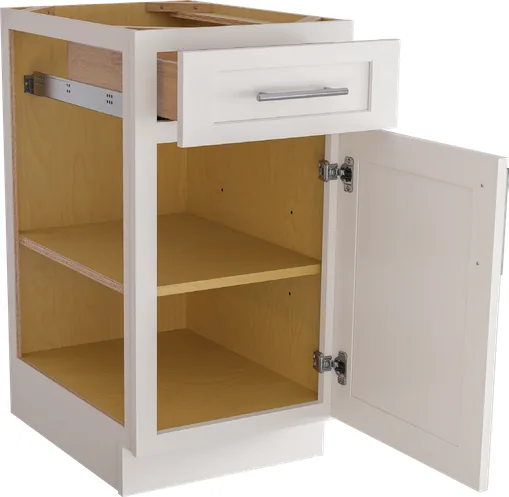
Read a cabinet the way an inspector would: box sides, bottom, back and shelves are usually plywood, particleboard or MDF, so they fall under the rule. Door frames and drawer boxes made of solid wood do not. A Shaker door with a solid frame and an engineered center panel has both: the frame is solid wood, the center panel is composite wood.
Cabinets made with veneered or laminated panels have their own provisions. EPA's deadline for laminated product producers was March 22, 2024.
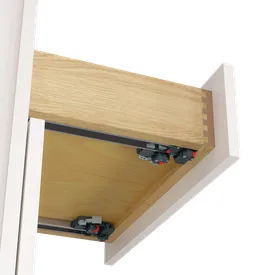
For ECG cabinets, the materials are listed on the cabinet construction page: a 1/2" plywood box, 3/4" plywood shelves, 5/8" solid wood dovetail drawers and 5-piece doors with a solid hardwood frame and an engineered center panel.
Drawer boxes and drawer slides matter less for this rule: slides are metal, and solid wood drawer sides are not composite wood. The face frame is solid wood on most framed cabinets.
How to Read a TSCA Title VI Label
Look for the words "TSCA Title VI compliant" on the panel, the cabinet or its carton. Regulated products sold, supplied or imported in the US must carry that label.
From June 1, 2018 to March 22, 2019, products could carry either a CARB Phase 2 label or a TSCA Title VI label. Since March 22, 2019, the federal label is the one that counts, and products made or imported after that date must be certified by an EPA-recognized third-party certifier. A carton that shows only an old CARB Phase 2 mark is a reason to ask questions.
- The words "TSCA Title VI compliant"
- The name of the manufacturer or fabricator on the label or its records
- A lot number or production date you can trace
- For panels, the third-party certifier's number
- A label on the cabinet or on every carton, depending on how the product ships
Products with 144 square inches or less of regulated composite wood are exempt from labeling, so small accessories may not carry a label at all.
Questions to Ask Any Cabinet Supplier
Ask in writing before the first order, and keep the answers with the job file. The answers protect you if a homeowner, a builder or an inspector asks later.
- Are the cabinets labeled TSCA Title VI compliant, and where is the label: on the cabinet, the carton or both?
- What composite wood is in the box, shelves, back and door panels?
- Can you send the compliance documentation for the line I am ordering?
- Do RTA and assembled versions use the same panels?
- If a component changes, will you tell me before it ships?
These questions belong on the same list as stock, freight and warranty. Add them to your cabinet quote checklist so every supplier answers the same way.
What to Tell Homeowners and Buyers
Keep it factual: name the rule, name the materials and show the label. Avoid health promises you cannot back up.
A short script works for most remodel clients: "These cabinets are built with a plywood box and solid wood drawers. Panels sold in the US must meet the federal TSCA Title VI formaldehyde limits, and this is the label." Builders can add the same line to the spec sheet in the model home.
Fresh cabinets in a closed room smell of finish and adhesive for a few days. Ventilating the room during and after install is common practice and costs nothing.
Where ECG Fits
ECG is a wholesale distributor. It lists the materials of every cabinet in its Spec Book and on the construction page, so you can answer the material question before the label question.
For compliance documentation on a specific order, ask the ECG team when you request your quote. Approved accounts get quotes within 1 business day, and the same plywood box is used in RTA and assembled cabinets.
Sources
Frequently Asked Questions
Is CARB Phase 2 the same as TSCA Title VI?
The emission limits are set at the same levels. Since March 22, 2019, regulated products sold in the US need the TSCA Title VI label; a CARB Phase 2 label alone is not enough.
What are the formaldehyde limits for cabinet panels?
0.05 ppm for hardwood plywood, 0.09 ppm for particleboard, 0.11 ppm for MDF and 0.13 ppm for thin MDF.
Do solid wood cabinet parts need to meet the formaldehyde rule?
No. The rule covers composite wood panels such as plywood, particleboard and MDF. Solid wood frames and drawer boxes are not composite wood.
Where do I find the TSCA Title VI label on a cabinet?
On the cabinet, on its carton or on both, depending on how the product ships. Look for the words "TSCA Title VI compliant".
What materials are ECG cabinets made of?
A 1/2" plywood box, 3/4" plywood shelves, 5/8" solid wood dovetail drawers and 5-piece doors with a solid hardwood frame and an engineered center panel. Ask the ECG team for documentation on your order.