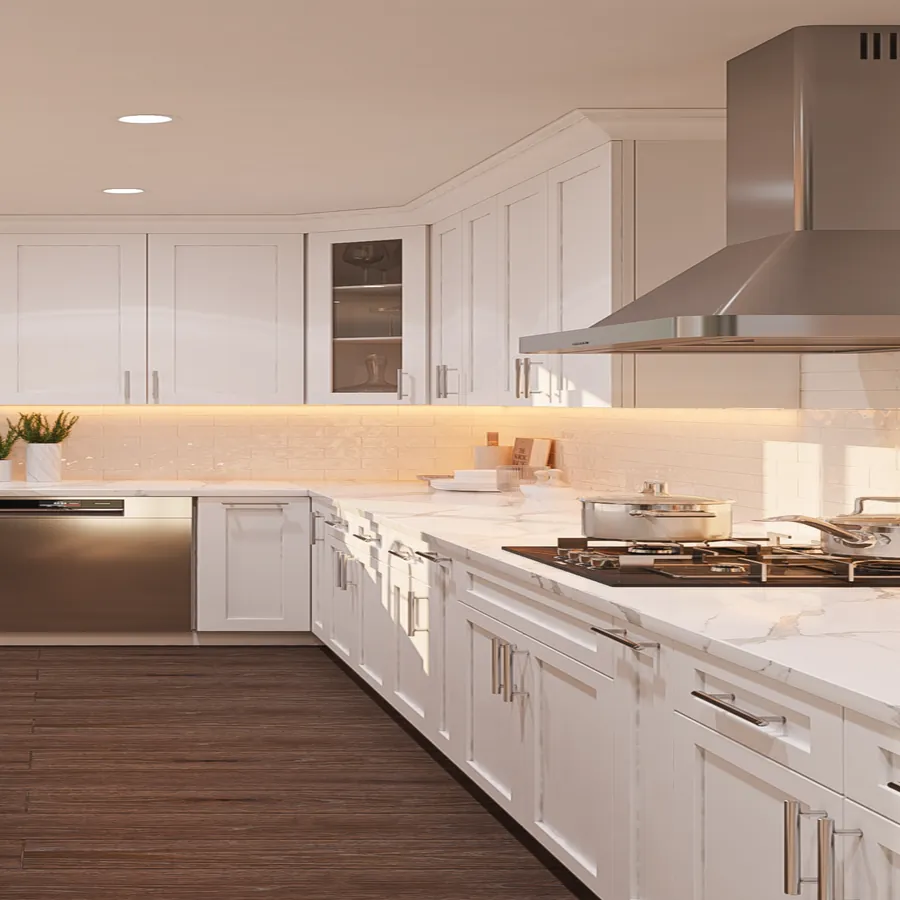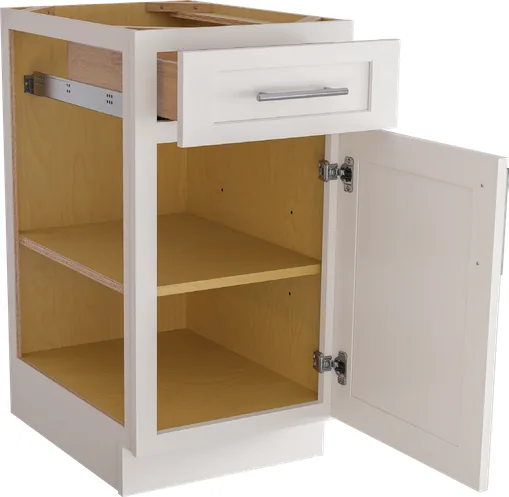
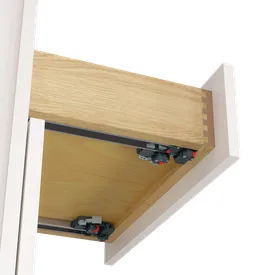
Dovetail drawers use interlocking wood joints at the corners, so the drawer front cannot pull away from the sides the way a stapled box can. Paired with full-extension soft-close glides, they are the clearest sign of a well-built cabinet.
Summary
- A dovetail joint locks two boards together with flared "tails" that fit into matching "pins." The shape resists being pulled apart in the direction a drawer is pulled every day.
- The drawer corner is where low-cost cabinets save money.
- The glide decides how the drawer feels and how much of it you can use.
- Soft-close matters on doors too.
What a Dovetail Drawer Is
A dovetail joint locks two boards together with flared "tails" that fit into matching "pins." The shape resists being pulled apart in the direction a drawer is pulled every day.
On a drawer box, dovetails join the front and back to the sides. Every time someone yanks a loaded drawer open, the joint takes the load instead of a staple or a bead of glue. That is why dovetail joinery has been the standard for quality drawers in furniture and cabinetry for a long time.
Clients notice drawers more than boxes. A drawer that sticks, sags or comes apart is the most common reason a kitchen feels cheap a few years after install, even when the doors still look new.
Dovetail vs Stapled and Doweled Drawers
The drawer corner is where low-cost cabinets save money. Here is how the common joints compare.
| Joint | How it holds | Typical weakness |
|---|---|---|
| Dovetail | Interlocking wood pins and tails, glued | Costs more to make |
| Doweled | Wood pins and glue in drilled holes | Can loosen as glue ages |
| Stapled or nailed butt joint | Fasteners through the side into the front | Front pulls loose under load |
| Cam or clip (flat-pack) | Metal fittings tightened on assembly | Works loose and needs re-tightening |
Material matters as much as the joint. A dovetail cut in solid wood holds far better than a joint in particleboard sides.
Undermount, Full-Extension Soft-Close Glides
The glide decides how the drawer feels and how much of it you can use. Concealed undermount, full-extension, soft-close is the combination to look for.
- Undermount glides mount under the drawer box, hidden from view, so the sides stay clean wood.
- Full-extension glides open the drawer all the way, so the back of the drawer is reachable.
- Soft-close glides catch the drawer near the end and pull it shut slowly, with no slam.
Side-mount, partial-extension glides cost less, but they show on the drawer sides and leave the last few inches of the drawer hard to reach.
Soft-Close Hinges on Doors
Soft-close matters on doors too. Concealed soft-close hinges stop the door from slamming and protect the finish and face frame.
Adjustment is the other half. A hinge that adjusts in six directions lets the installer line up doors on site, which saves time on every kitchen with an out-of-level floor or a wall that is not flat.
Hinges also need care over time. Re-tightening hinge and glide screws periodically is part of the ECG care guidance, and it keeps doors aligned and closing softly for years.
Where Drawer Quality Matters Most in a Kitchen
Drawers near the range and sink work hardest. Plan the strongest drawers where the heaviest loads go.
- Pots and pans: wide drawer bases next to the range carry the heaviest weight.
- Dishes: many clients now ask for plates in deep lower drawers instead of upper cabinets.
- Utensils and tools: shallow top drawers open the most times per day.
- Bathroom vanities: drawers take daily use plus humidity from showers.
In each case, a dovetail box on a full-extension glide keeps the drawer square and the contents reachable. Roll-out trays (ROT15 to ROT36) bring the same easy access to standard base cabinets with doors.
What ECG Cabinets Use
Every ECG cabinet uses the same drawer and hinge spec, in all four Shaker finishes and in both RTA and assembled formats.
| Part | ECG specification |
|---|---|
| Drawer box | 5/8" solid wood, dovetail joinery |
| Drawer glides | Concealed undermount, full-extension, integrated soft-close |
| Hinges | 6-way adjustable concealed, soft-close |
| Cabinet box behind them | 1/2" premium-grade plywood |
Drawer base cabinets run from DB12-3 to DB36-3 with three drawers, plus a DB30-2 with two deep drawers, all 34-1/2" high and 24" deep. See them in the wholesale base cabinet catalog, and every part in the cabinet construction specs.
How to Check Drawers on a Sample or Delivery
You can judge a drawer in under a minute. Pull one out and look at the corner, the bottom and the glide. Door samples and the first delivery are good chances to check, before the drawers are full of a client's things.
- Corner joints show interlocking dovetails, not staples or nail heads
- Drawer sides are solid wood, not a printed or wrapped panel
- Glides are hidden under the box, not mounted on the sides
- The drawer opens all the way out
- A light push near the end closes it slowly, with no slam
- Doors close softly and the hinges have adjustment screws
Ordering RTA? The drawer and hinge spec is the same. See how to judge RTA cabinet quality before your first order.
Sources
Frequently Asked Questions
Are dovetail drawers worth it?
Yes for kitchens. Drawers carry heavy loads and get pulled many times a day, and dovetail joints resist the front pulling away better than stapled or doweled corners.
What is the difference between soft-close and self-close?
Self-close pulls the drawer or door shut on its own; soft-close also slows it down at the end so it closes quietly without a slam.
Do ECG RTA cabinets have the same drawers as assembled?
Yes. RTA and assembled cabinets use the same 5/8" solid wood dovetail drawers on concealed undermount, full-extension soft-close glides.
How can I tell if a drawer has dovetail joints?
Pull the drawer out and look at the front corners: interlocking wood "tails" and "pins" mean dovetail; staples, glue lines or dowels mean a lighter joint.
Do ECG cabinets come with soft-close drawers?
Yes. Every ECG drawer is 5/8" solid wood with dovetail joints on full-extension soft-close glides, and doors have soft-close hinges.