Builder grade vs contractor grade cabinets are sales labels, not standards. Both usually mean an entry-level stock line, and neither tells you how the box is built. Compare the spec sheet: box material, drawer joinery, hinges, glides and warranty.
Summary
- Builder grade usually means the lowest-cost cabinet a builder can put in every unit.
- Contractor grade is a name suppliers give to lines sold to remodelers and small contractors.
- Two suppliers can sell very different cabinets under the same label.
- The table compares what to watch for in entry-level lines with what to ask for, and shows the ECG spec for each part.
What Builder Grade Cabinets Usually Means
Builder grade usually means the lowest-cost cabinet a builder can put in every unit. It is chosen for price and volume, not for how long it lasts.
The label has a mixed reputation. Apartment Therapy, for one, asks whether buyers should avoid builder-grade materials or whether the name just has a bad reputation. The honest answer: it depends on what is inside the box.
Entry-level lines often save money in places buyers do not see at first: thinner box panels, stapled drawer boxes and basic hinges. Not every builder-grade line does all three, which is exactly why the label alone is not enough.
What Contractor Grade Cabinets Usually Means
Contractor grade is a name suppliers give to lines sold to remodelers and small contractors. Sometimes it is the same product as builder grade; sometimes it is one step up.
There is no industry definition behind either term. The closest thing to a real standard is ANSI/KCMA A161.1, the performance and construction standard written by the Kitchen Cabinet Manufacturers Association, with a voluntary third-party certification program. A grade name on a price sheet is not the same thing as a tested standard.
Why the Grade Label Does Not Tell You What You Are Buying
Two suppliers can sell very different cabinets under the same label. One contractor-grade line can have a plywood box; another can use particleboard with a paper finish inside.
Your name is on the kitchen, so ask questions the label cannot answer:
- What are the box sides and back made of, and how thick are they?
- How is the drawer box joined: dovetail, dowel or staples?
- Are the glides full-extension and soft-close?
- Are the hinges concealed and adjustable?
- Is the face frame solid wood?
- What does the warranty cover, and for how long?
Spec-by-Spec: Labels vs Real Construction
The table compares what to watch for in entry-level lines with what to ask for, and shows the ECG spec for each part.
| Part | Watch for in entry-level lines | Ask for | ECG spec |
|---|---|---|---|
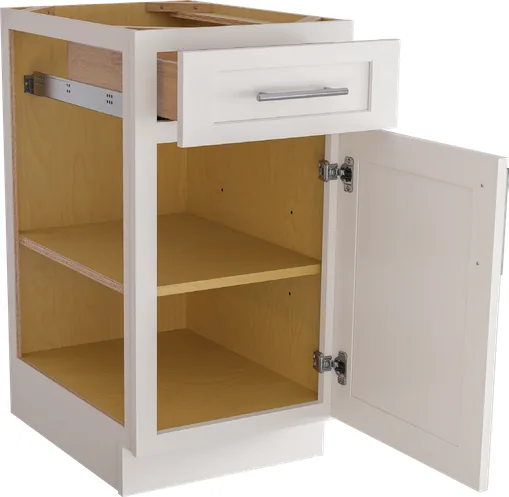
| Box sides | Particleboard or thin panels | Plywood, stated thickness | 1/2" premium-grade plywood |
| Back panel | Thin hardboard back | Plywood back | 1/2" premium-grade plywood |
| Shelves | Thin shelves that sag | Thick, adjustable shelves | 3/4" plywood, adjustable |
| Drawer box | Stapled or glued corners | Solid wood, dovetail joints | 5/8" solid wood, dovetail |
| Drawer glides | Side-mount or roller glides | Undermount, full-extension, soft-close | Concealed undermount, full-extension, soft-close |
| Hinges | Basic hinges, no soft-close | Concealed, adjustable, soft-close | 6-way adjustable concealed, soft-close |
| Face frame | Not stated | Solid hardwood | Solid hardwood |
| Door | Not stated | Solid wood frame | Full overlay 5-piece solid wood, engineered center panel |
| Warranty | Short or unclear terms | Written terms you can explain | Limited lifetime, original purchaser |
The full part list, including the base frame and toe kick, is on the plywood cabinet construction specs page.
Look closely at the drawer slides: side-mount slides on cheaper lines show from the side and wear faster, while undermount, full-extension soft-close glides stay hidden and carry heavier loads.
Which Cabinet Level Fits Which Job
Match the cabinet to how hard the kitchen will be used and who will live with it.
| Job | What matters most | What to check first |
|---|---|---|
| Rental remodel | Durability under heavy use | Box material and drawer joinery |
| Flip | First impression and fast schedule | Finish, soft-close and stock |
| Spec home or new build | One repeatable spec across units | Stocked finishes and lead time |
| Client remodel | Your name and the callback risk | Warranty terms and hardware |
ECG keeps one construction level for every SKU: the same box in all four Shaker finishes, RTA or assembled. Builders can repeat it across a project; see the cabinet supplier for builders page.
Where Entry-Level Cabinets Cost You Later
The savings in an entry-level box usually show up as callbacks. The parts that fail first are the ones that move or get wet.
Drawers take the most daily abuse, so stapled corners and roller glides are often the first complaint. Sink bases see leaks, and particleboard swells when it stays wet, while plywood is more tolerant of a leak. Screws in particleboard can strip when hinges are re-adjusted, which matters every time a door needs aligning after the house settles.
Price the callback, not just the cabinet. One return trip to fix a drawer or replace a sink base floor can cost more than the difference between two lines on the original quote.
How to Check a Cabinet Before You Commit
Check the product, not the label. Four steps take less than a day.
- Ask for the spec sheet and compare it with the table above.
- Order a Shaker door sample to see the door and finish in hand.
- Read the warranty exclusions, not only the headline. The limited lifetime warranty explained page shows what ECG covers and excludes.
- Open a drawer on the first delivery and check the joinery and glides.
Sources
Frequently Asked Questions
Is contractor grade better than builder grade?
Not by definition. Both are sales labels with no shared standard. Compare the box, drawers, hinges, glides and warranty on the spec sheet.
Are builder grade cabinets made of particleboard?
Many entry-level lines use particleboard boxes, but not all. Ask for the box material and thickness before you buy.
What makes a cabinet better than builder grade?
A plywood box, solid wood dovetail drawers, full-extension soft-close glides, adjustable concealed hinges and clear warranty terms.
What should I ask a supplier instead of "is it builder grade"?
Ask for the box material and thickness, the drawer joinery, the drawer slides and hinges, the finish and the warranty in writing. Those five answers tell you more than any grade name.
Are ECG cabinets builder grade or contractor grade?
ECG does not use either label. Its spec is a 1/2" plywood box, 3/4" plywood shelves, 5/8" solid wood dovetail drawers on soft-close glides and a limited lifetime warranty.