In the lazy susan vs blind corner cabinet choice, a lazy susan gives the easiest access in an L-shaped corner, while a blind corner base fits when one run needs to stay shorter or an appliance sits close to the corner. ECG stocks the LSB33 and LSB36 lazy susans and the BBC36-42 and BBC42-45 blind corners.
Summary
- Choose a lazy susan when both runs of the L have room to give up the corner.
- ECG stocks five corner base SKUs, all 34-1/2" high like every other base.
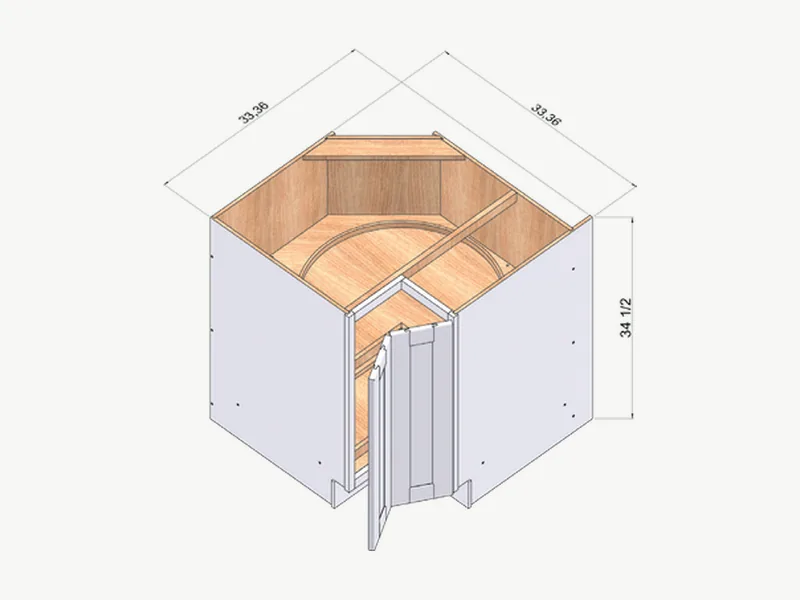
- A lazy susan base sits right in the corner and uses rotating shelves, so items come to the front with a turn.
- A blind corner base runs along one wall and slides part of its box into the corner, behind the cabinet on the other wall.
Lazy Susan vs Blind Corner: The Short Answer
Choose a lazy susan when both runs of the L have room to give up the corner. Choose a blind corner when one run is short, or when a range, dishwasher or window sits near the corner.
Both turn the dead space where two base runs meet into storage. The difference is how you reach it: a lazy susan opens at the corner itself, a blind corner opens along one run and hides part of its box behind the other.
ECG Corner Base Cabinet Sizes
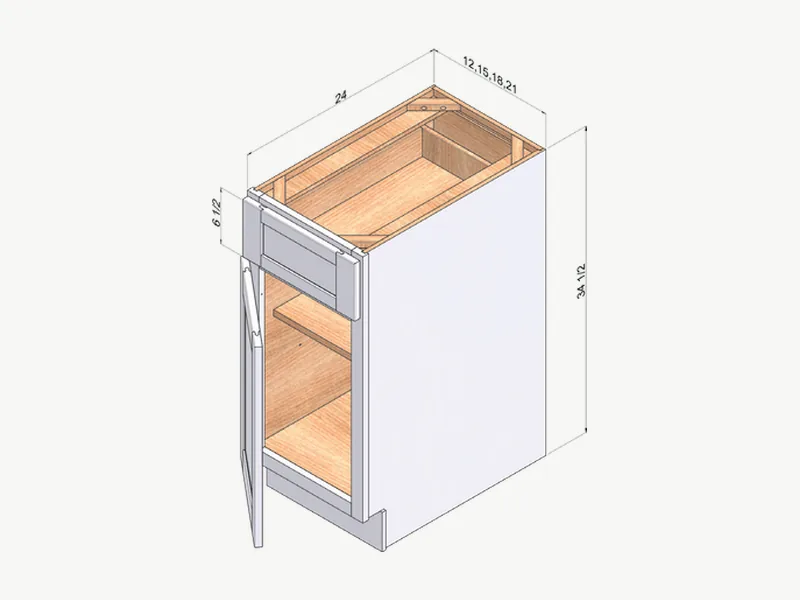
ECG stocks five corner base SKUs, all 34-1/2" high like every other base. Widths come from the catalog; depths not published online are in the Spec Book.
| SKU | Type | Width | Height | Depth |
|---|---|---|---|---|
| LSB33 | Lazy susan base | 33" | 34-1/2" | In the Spec Book |
| LSB36 | Lazy susan base | 36" | 34-1/2" | In the Spec Book |
| BBC36-42 | Base blind corner | 36" | 34-1/2" | 24" |
| BBC42-45 | Base blind corner | 42" | 34-1/2" | 24" |
| CSB36 | Corner sink base | 36" | 34-1/2" | In the Spec Book |
Every base size is on the wholesale base cabinets page. The number after the dash on the BBC codes is not a drawer count; check what it means for wall space and pull-out in the Spec Book before you draw the corner.
Corner bases share the base run's recessed kick space and toe kick, so they line up with the rest of the kitchen at the floor.
How a Lazy Susan Corner Base Works
A lazy susan base sits right in the corner and uses rotating shelves, so items come to the front with a turn. Nothing is lost at the back of the corner.
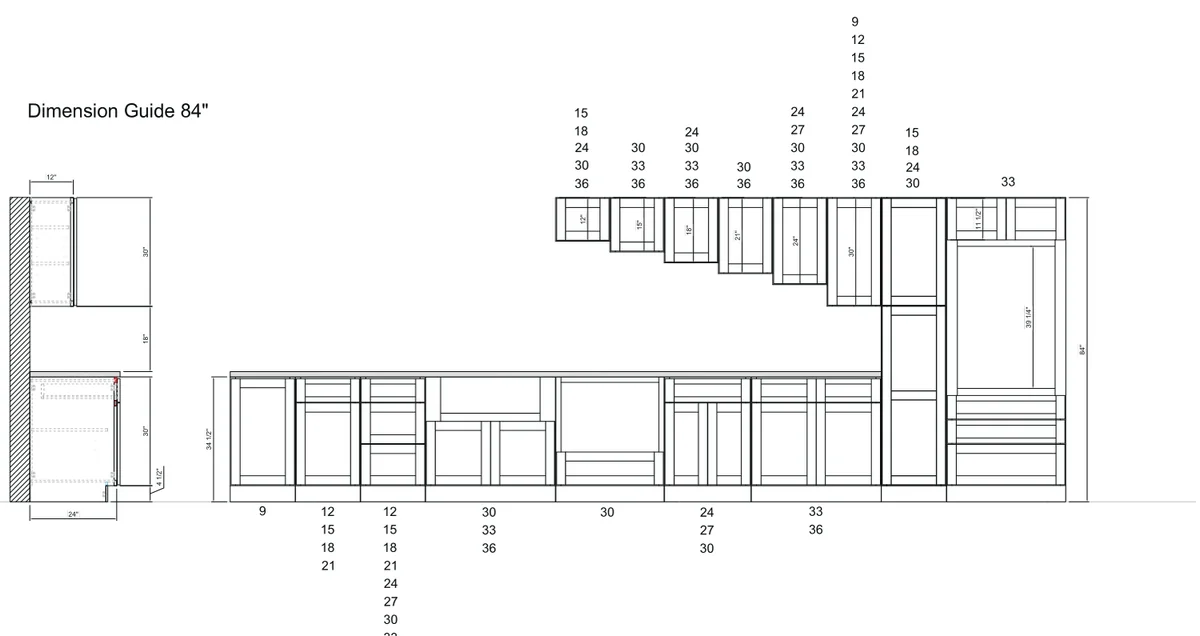
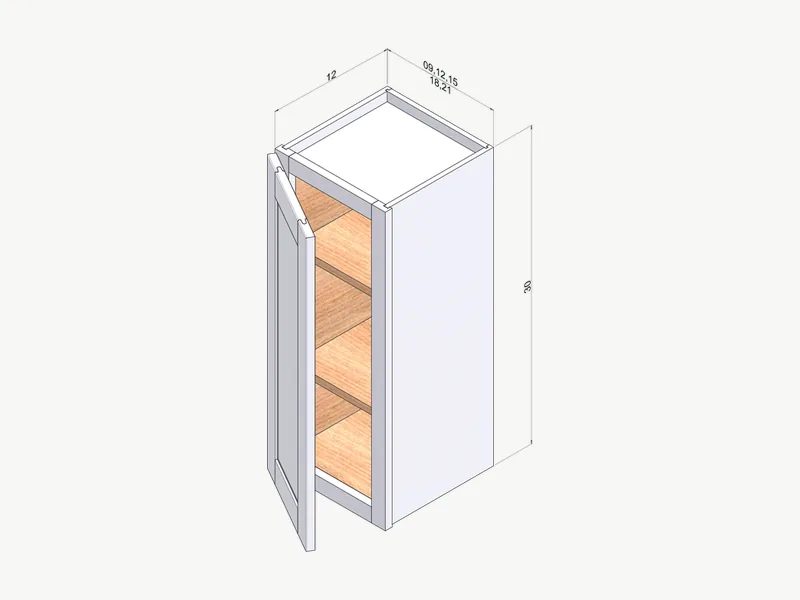
Because it fills the corner, a lazy susan takes space along both walls. Plan the two runs from the corner out, using the footprint in the Spec Book. Above it, the 24" wide diagonal corner wall (DCW2430, DCW2436, DCW2442, also in glass door) or the wall easy reach corner (WER2430, WER2436, WER2442) gives a matching corner on top, in the same 30", 36" or 42" height as the rest of the uppers.
How a Blind Corner Base Works
A blind corner base runs along one wall and slides part of its box into the corner, behind the cabinet on the other wall. The door sits on the visible part; the blind part is reached from that opening.
That makes it the flexible choice for layouts where one run must stay short. ECG BBC units are 24" deep like standard bases and come 36" and 42" wide. Above, the wall blind corner (WBC3030, WBC3036 or WBC3042) does the same job for the uppers; its width is in the Spec Book. See the wall cabinet SKU list for every corner wall unit.
Lazy Susan vs Blind Corner: Side by Side
The table compares the two on what matters at layout and install.
| Factor | Lazy susan (LSB) | Blind corner (BBC) |
|---|---|---|
| ECG widths | 33", 36" | 36", 42" |
| Access | Easiest: rotate to reach items | Reach into the blind part through one opening |
| Wall space | Takes space on both runs | Runs along one wall into the corner |
| Layout it fits | L-shape with room on both runs | One short run, or appliance near the corner |
| Matching wall corner | DCW or WER, 24" wide | WBC, in 30", 36", 42" heights |
| Depth | In the Spec Book | 24" |
Which Corner Fits Which Layout
Start from what sits next to the corner. Appliances and windows usually decide it.
- Both runs long, no appliance within reach of the corner: LSB33 or LSB36
- A dishwasher, range or sink base close to the corner on one run: BBC on the other run
- One run shorter than the lazy susan needs: BBC36-42 or BBC42-45
- Sink planned in the corner itself: CSB36 corner sink base
- Doors or drawers next to the corner that could hit each other: add a filler at the corner
Fillers and scribe close the leftover space at corners; see fillers, scribe and light rail for which piece goes where.
Checklist Before You Order a Corner Cabinet
Check the corner on the drawing and on the wall before you lock the SKU.
- Measure both walls from the corner, at counter height.
- Check the corner is square; out-of-square corners need filler or scribe.
- Mark appliances, windows and the sink center line near the corner.
- Pick the base corner, then the matching wall corner in the same height as the uppers.
- Confirm the corner footprint and pull-out in the Spec Book.
Send the layout with your wholesale cabinet quote request and the corner SKUs come back confirmed, with stock and pricing, within 1 business day. Base, wall and pantry sizes are in one chart in standard kitchen cabinet sizes.
Frequently Asked Questions
Is a lazy susan better than a blind corner cabinet?
For access, yes: a lazy susan brings items to the front with a turn. A blind corner fits more layouts when one run is short or an appliance sits near the corner.
What sizes are ECG lazy susan cabinets?
The LSB33 is 33" wide and the LSB36 is 36" wide, both 34-1/2" high. The depth and corner footprint are in the ECG Spec Book.
What wall cabinet goes above a blind corner base?
A wall blind corner (WBC3030, WBC3036 or WBC3042) matches it in 30", 36" or 42" heights. Above a lazy susan, use a diagonal corner wall (DCW) or easy reach corner (WER).
Which corner cabinet holds more?
A lazy susan uses more of the corner and brings items to the front; a blind corner holds deep items but is harder to reach without a pull-out.
Can a sink go in a corner cabinet?
Yes, with a corner sink base such as the ECG CSB36. It replaces the lazy susan or blind corner in that corner.